By Dr. Kevin P. Wallace
Van of Valor
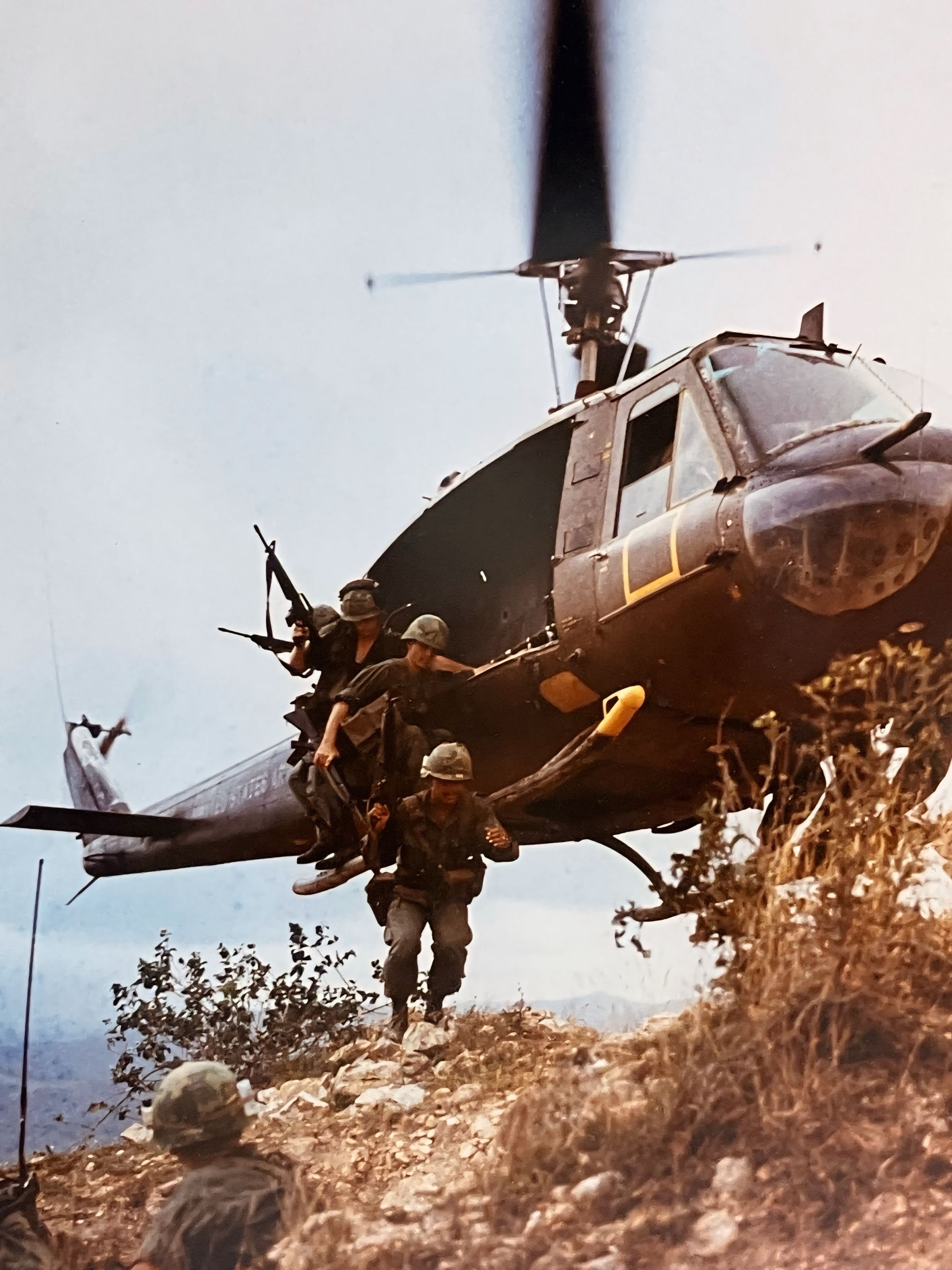
NORTH PORT, Fla. – The helicopter rotor blades thundered overhead, kicking up clouds of dust as the Huey skimmed low over the treetops.
Inside, young American soldiers stood hunched against the doorframes, M16s clutched to their chests, eyes fixed on the green hell rushing beneath them.
In seconds, they would drop into a landing zone that might already be zeroed in by enemy machine guns.
For Sgt. Barry McAlpine of B Troop, 1/9 Cavalry, this was just another Tuesday.
“Dustoff, I’ve got two wounded, maybe three. We’re taking fire from the rocks, can you get in?”
The year was 1967. The place was the An Loa Valley, Republic of Vietnam. And the voice on the radio belonged to a young specialist who had just watched his squad leader die.
To understand what happened next, one must first understand McAlpine’s character. He always does what’s right… what’s just.
McAlpine didn’t have to be in Vietnam.
He didn’t have to become an elite Bravo Blues either.
Yet he did, becoming call-sign Blue 31, of the elite team of reconnaissance soldiers, vital for airmobility, scouting, and search-and-destroy operations.
Drafted in 1965, McAlpine was initially stationed in Germany, living what many soldiers would consider a cushy assignment: playing baseball for the Army.
He was literally drafted to play baseball while his peers were being drafted for Vietnam; Ted Williams, who traded his bat for a cockpit in two wars, would shudder at the irony.
So did McAlpine. He couldn’t stomach it.
As the conflict in Southeast Asia escalated, McAlpine found himself restless. He wanted to be where the fight was.
He volunteered for Vietnam.
Denied.
Then he volunteered again.
Denied.
And then a third time.
His third request was approved.
McAlpine wasn’t looking for a safe rear-echelon posting. He wanted the sharp end of the spear. He found it in B Troop, 1st Squadron, 9th Cavalry Regiment (1/9 Cav.), the legendary “Bullwhip Squadron” of the 1st Air Cavalry Division (1 ACD).
This was the unit that pioneered “Hunter-Killer” operations: a lethal ballet of aerial reconnaissance and rapid-response infantry that would account for more than half of the 1 ACD’s major contacts and enemy kills during the entire war.
McAlpine became an Aero-Rifle squad leader, Blue 31 of the infantrymen who rode shotgun in the sky, ready to drop into hot landing zones at a moment’s notice.
For McAlpine, this happened hundreds of times, and one notable day was February 27, 1967.
The mountains near the An Loa Valley were unforgiving terrain – steep, rocky, and perfect for ambush. McAlpine’s squad was conducting a sweep through a rocky defile when the world exploded.
Intense automatic weapons fire erupted from concealed positions. Two men were cut off from the squad. Three others went down wounded. The rest of the squad, two full teams, hit the dirt, pinned down by an enemy they couldn’t even see.
McAlpine had cover. He could have stayed low, returned fire, waited for support.
Instead, he left his protected position and crawled forward.
Bullets snapped overhead and sparked off rocks as he dragged himself toward the wounded, administering first aid while enemy gunners tried to kill him. One by one, he pulled the casualties to the rear, handing them off for evacuation before turning around and crawling back into the kill zone.
Then his squad leader was killed.
Without hesitation, McAlpine took command. He rallied the remnants of his squad and led them into the rocks, hunting the hunters. But when his men couldn’t locate the enemy position, McAlpine did something that defied conventional tactics.
He went alone.

Moving through the rocky defile with the patience of a predator and the fury of a man protecting his brothers, McAlpine systematically cleared the remaining North Vietnamese Army (NVA) soldiers from the area. When it was over, the enemy positions were silent.
For that action, he was awarded his first Silver Star.
It wouldn’t be long until his valor was summoned again.
Three months later, on May 27, near Duc Pho, McAlpine’s platoon walked into a trap: a reinforced Viet Cong (VC) company, well-entrenched and waiting.
The firefight was immediate and brutal. Two serious casualties went down.
The platoon was forced to pull back into a tight defensive perimeter, surrounded and taking fire from all directions. As the hours wore on, ammunition ran low. Water supplies; gone.
An urgent resupply mission was called in. The helicopter came thundering toward the perimeter, a Huey loaded with ammunition and water, the difference between life and death.
The pilot came in too low, below the tree line, and off course slightly.
It was enough for the VC, who found the range, and took an accurate shot.
The helicopter took hits and went down hard, crashing upside down, and outside the friendly perimeter. Now there was a new problem: a downed crew, wounded and trapped in the wreckage, surrounded by VC.
Nobody would have faulted McAlpine for staying in the perimeter. He was a fire team leader now, responsible for his men. The crash site was a deathtrap.
He didn’t wait for orders.
Blue 31 left the safety of the perimeter and ran into hail of machine-gun fire toward the burning aircraft.
Enemy rounds chewed up the ground around him as he reached the wreckage. Inside, he found the pilot trapped, wounded, unable to free himself.
Working under fire, with the aircraft potentially ready to explode, McAlpine freed the pilot and co-pilot, who were both stuck in. Under intense fire, McAlpine cut each of them out, then carried the most-severely wounded, the pilot, back to safety. His actions saved his life and prevented more serious injuries to four other soldiers.
For that, he was awarded a second Silver Star.
McAlpine was wounded three times during his tour, earning three Purple Hearts. Each one could have sent him home earlier. Each time, he chose to stay.
The nature of his wounds, like so many details of his service, speaks to the brutal reality of the Hunter-Killer mission. These were not soldiers who operated from fortified bases. They lived in the jungle, dropped out of helicopters into enemy territory, and fought at close quarters against an enemy who knew the ground better than they did.
By the time he was finally sent home after his third wound, McAlpine had accumulated an extraordinary array of decorations: two Silver Stars, a Bronze Star, and three Purple Hearts. But ask any veteran of the 1/9 Cav., and they’ll tell you, the medals only tell part of the story.
The 1/9 Cav. operated differently than any unit before them. Their Hunter-Killer concept was revolutionary: Aero-Scouts in light observation helicopters (White platoons) would locate the enemy, Aero-Weapons (Red platoons) would suppress and fix them in place, and Aero-Rifle platoons (Blues), men like McAlpine, would insert to finish the fight.

First Silver Star. 🇺🇸
It was dangerous work. The scout helicopters flew low and slow, deliberately drawing fire to locate enemy positions. The gunships followed close behind.
And the infantry? They went in wherever the enemy was found, often outnumbered, always outgunned until air support could arrive.
The statistics speak for themselves: the 1/9 Cav. initiated over half of the 1 ACD’s major contacts and accounted for more than half of its enemy kills.
But statistics don’t capture what it meant to be a twenty-year-old soldier dropping into a hot LZ, knowing that the helicopters overhead were your only lifeline.
Matthew Brennan’s book “Hunter-Killer Squadron” preserves the personal narratives of these men, McAlpine among them, offering future generations a window into what they endured and accomplished.
What makes a man volunteer three times for combat?
What drives a soldier to leave cover and crawl toward wounded comrades while people are shooting at him?
What possesses a fire team leader to run into machine-gun fire toward a crashed helicopter to pull a stranger from the wreckage?
The citations use words like “gallantry,” “courage,” and “selfless.” They talk about “the highest traditions of military service.” And all of that is true, as far as it goes.
But perhaps the real answer lies in something simpler: Barry McAlpine believed in his mission and his men.
He chose to be there.
He chose to fight.
And when the moment came, when the bullets were flying and the wounded were calling out and the aircraft was burning, he chose to act.
In the rocky defiles of the An Loa Valley and the jungle near Duc Pho, in the pages of official citations and the memories of those who served alongside him, McAlpine’s choices echo across the decades.
He was one of the Hunter-Killers. He was one of the best.
And when his country called, when his brothers needed him, he never hesitated.
After he returned from the war, McAlpine used the G.I. Bill to go back to school – not for an easy path, but to become a chiropractor. Pole-vaulting from Staff Sergeant to Dr. McAlpine was another journey, one from combat to clinical practice.
He enrolled at the Palmer College of Chiropractic, graduating in 1971, and in 1973 founded the McAlpine Chiropractic Group in Holland, Michigan, where he practiced for over four decades.
His daughter, Dr. Ann McAlpine, joined him in 2013, carrying forward a family legacy of healing. Now retired, Dr. McAlpine leaves behind a dual legacy: dedicated healthcare provider and celebrated veteran, his stories of valor preserved in the Military Times and Witness to War.
During the Van of Valor mission – across 27,106 miles of American highways, byways, and trails – we met some amazing people.
Rarely has someone impacted me the way Barry McAlpine has. Maybe it was our enlisted connection. Maybe it was the thirst to do something bigger than ourselves. Maybe it was the pursuit of academic rigor after hard combat.
Some very unique fabrics tie our tapestries of character.

He hated it. So he volunteered for Vietnam. Denied. Volunteered again. Denied. A third time. Approved. 🇺🇸
For me, writing this story has been one of the greatest honors of my post-military career.
Barry McAlpine is cut from an incredibly resilient thread of the American tapestry. He is the man who will run into hell to save you.
He is also the man who may bloody your nose right there in the airport or on the college steps if you dare disrespect his men or the country he loves.
Some think McAlpine is a dying breed. They are wrong.
I am certain McAlpine carries that rare strength which cannot be killed, which refuses to die, and which will be right there when America calls again.
He wrote these words himself. Read them, and you will understand:
I AM A SOLDIER
I am a Soldier.
I fight for freedom, I fight for the United States of America.
I fight against ternary oppression and evil.
I have been taught by Warriors, trained by experience, tried by adversity and tested by fire.
I am a volunteer in this Army.
No one made me join this fine fraternity of Warriors.
I am enlisted for all eternity.
I will either retire from this Army, or be silenced by age, but I will never get out, sell out, be talked out, or pushed out.
I am faithful, reliable, capable and dependable.
I know I can be used by God in this work and I am there.
If there is a Soldier that needs my teaching and counsel, I am there.
If there is a leadership role for me, I am there.
I am not a baby.
I do not need to be pampered, petted, primed up, pumped up, picked up or pepped up.
I do not need to be cradled, cuddled, cared for or catered to.
I am a Soldier.
No one has to call me to report, remind me, write me, visit me, entice me or lure me.
I am a Soldier.
Whatever it takes, I am ready to give and get it done.
I am committed to this duty and I never give up.
I do not let anyone make me negative about my mission.
I do not lose faith in my God or my chain of command.
When I am called home I will stand tall.
I AM A SOLDIER.
Into the Hunter-Killer sky he would fly. Into the canopy he would go.
Where angels fear to tread.
Note: If you enjoyed McAlpine’s story and want a deeper dive into the Reds, Whites, and other parts of the Hunter-Killer story, visit www.HelpVoV.com and enter the Blog section.
To view a special music video and song created to honor McAlpine’s service, visit here: https://youtu.be/BxJyAkteEVY
Make a one-time donation
Make a monthly donation
Make a yearly donation
Choose an amount
Or enter a custom amount
Your contribution is appreciated.
Your contribution is appreciated.
Your contribution is appreciated.
DonateDonate monthlyDonate yearly
Leave a Reply to The Creative SPOTCancel reply