Special Commentary By Dr. Kevin Wallace
Van of Valor
NORTH PORT, Fla. – I used to be on a pretty strong speaking circuit, talking about suicide and resiliency.
You walk into a room to talk about survival, carrying the weight of your own story.
You speak about the invisible shrapnel, the dark trenches of the mind, and the fragile bridge between despair and hope.
You do it because service doesn’t end with retirement; it evolves.
That’s why I was at Hanscom Air Force Base back in March of 2020 when COVID-19 first hit our shores. I was there to look Airmen, NCOs, officers, and community leaders in the eye and tell them my story of suicidal ideation and resiliency after my combat injuries. The goal, as always, was to connect to protect.
That mission, which you can read about in the official Hanscom coverage of my visit in their story titled, “Connect to Protect: Wounded Warrior shares personal story of suicidal thoughts, recovery.” It was about breaking stigma; nothing has changed, really.
It’s about telling a room full of warriors that asking for help isn’t a sign of weakness, but an act of profound courage. It’s a message I carry from my own journey, marked by the physical reminder of a Purple Heart and the deeper complexities symbolized by a Bronze Star with Valor.
But sometimes, after you give that talk, the universe sends you a powerful reminder of why you do it. It doesn’t always come in uniform.
After the formal duties at Hanscom, my friend David Hart — a former Army Ranger who now serves in the defense industry — and I had the privilege of meeting Marc Fucarile.
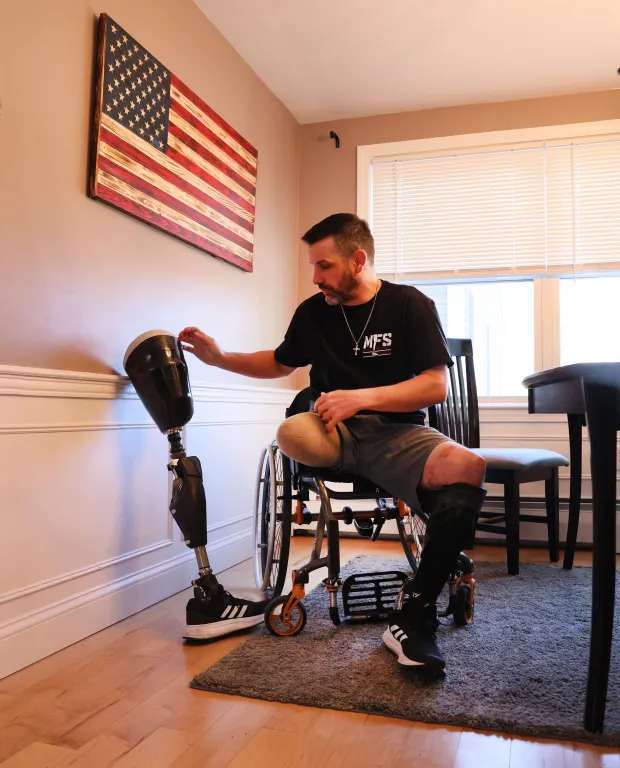
Marc is a name many remember from the headlines of April 15, 2013: the Boston Marathon Bombing. He was the last survivor to leave the hospital after 80 days, having lost his right leg, suffered severe burns, and sustained other life-altering injuries.
Sitting to meet his new then-Fiancee (now wife) and talk over breakfast, you don’t just see a civilian victim of terrorism. You meet a fellow survivor. The kinship is immediate, wordless.
There’s a recognition in his eyes that I know well — the understanding of a life violently interrupted, of a body forever changed, of the long, brutal road back to a new normal.
David, with his Ranger background, recognized it too, and befriended Marc months before I had. We are still three men from vastly different paths — Air Force, Army, and civilian — standing on common ground forged in trauma and resilience.
But what truly humbled me, what shifted this from a simple meeting into a lesson, was not Marc’s story of survival, but his story of service.
Marc didn’t let his attack define his end.
It defined his new mission.
He co-founded the ReM.A.R.C.able Foundation and has been instrumental with 50 Legs, a non-profit dedicated to providing prosthetic devices and support to amputee children and adults who cannot afford them.
He’s turned his nightmare into a lifeline for others.
He visits schools, talks to communities, and advocates tirelessly, ensuring that the evil of that day is met, and outweighed, by an ongoing force of good.
Sitting with him, I realized our messages were parallel lines, converging on the same truth.
My talk at Hanscom was about internal resiliency — arming our own minds against the enemy within. Marc’s work exemplifies external resiliency — building up the community around you, creating support structures so robust that no one has to fall alone.
He is the living embodiment of the “connect to protect” ethos, but for his city, for fellow amputees, for anyone facing a mountain that seems too steep to climb.
Meeting Marc Fucarile reaffirmed a core tenet of my own mission: the battle for resiliency doesn’t care about your branch of service, your job title, or whether your wounds were sustained in a combat zone or on a hometown sidewalk.
The spirit to fight through, and then to turn around and pull the next person up, is a universal valor.
I went to Hanscom to share my story with warriors. I left Boston having met another one. Marc’s physical scars are different from mine or any other person’s, but the strength they represent is the same. He reminds us all that the most powerful response to tragedy is not just to survive, but to serve.
To learn more about Marc Fucarile’s ongoing mission of community resiliency and support, visit the ReM.A.R.C.able Foundation.
To read more about the Van of Valor, visit www.HelpVoV.com.
(Kevin P. Wallace is a retired Air Force Senior Master Sergeant, co-founder of the veteran initiative Van of Valor, and a resilience advocate who speaks nationwide.)
Leave a Reply