By Dr. Kevin Wallace
Van of Valor
SAINT LOUIS, Mo. – In the dense, triple-canopy jungles of Vietnam, where the enemy was a ghost and the terrain an impassable wall, the U.S. Army needed a new way to fight.
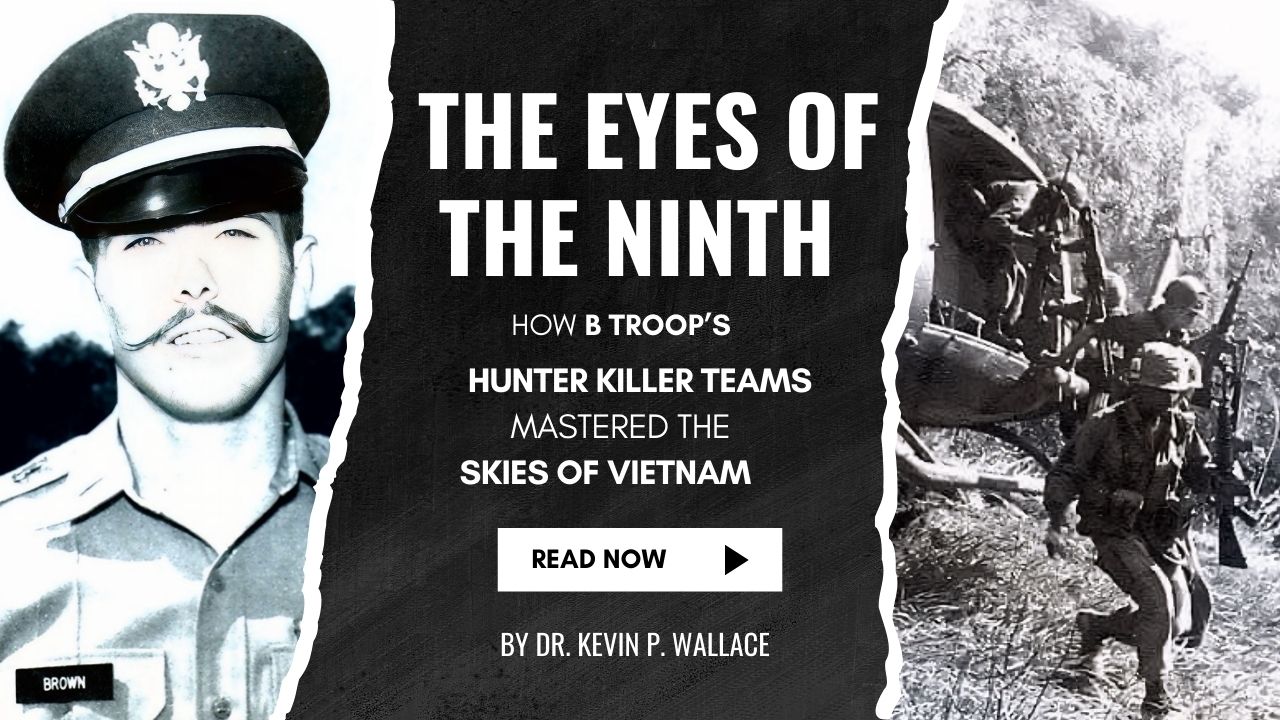
The answer soared above the treetops in a whirlwind of rotor blades and a storm of fire. This was the aerial reconnaissance unit of “The Headhunters,” the 1st Squadron, 9th Cavalry. Within it, B Troop perfected one of the war’s most devastating tactical innovations: the Hunter Kill Team.
This was not a random collection of aircraft, but a finely tuned orchestra of destruction. Each element had a specific, interlocking role, designed to find, fix, and finish the enemy.
The team consisted of the “Hunter” element — the OH-6A “Loach” scout helicopters (Whites) and the AH-1G Cobra gunships (Reds) — and the “Kill” element — the UH-1 “Huey” Slicks carrying the Air Rifle Platoon (Blues). Helicopters varied through the war, but the above list were the primary platforms.
(Story continues below):

The Hunter Element: The Bait and the Trap
The deadly dance always began with the scouts. The Whites flew the nimble, egg-shaped OH-6A Loaches, often called “Flying Bicycles” for their agility and fragility.
The Loach pilot’s job was to be the bait. They would skim the treetops, dart into valleys, and hover low over suspicious trails, deliberately drawing fire.
“We were the guy poking the tiger with a short stick,” said Col. Larry Brown, scout pilot. “The mission was to get the enemy to reveal himself. You’d be flying at 90 knots, three feet off the ground, and you’d see a muzzle flash from a spider hole. In that instant, you’d break hard, mark the spot with a smoke grenade, and call in, ‘Troops in contact, and I’ve got his position.’”
One such act of bravery defined the role. Brown’s Loach was once raked by .51 caliber anti-aircraft fire, shattering the Plexiglas and wounding his observer. Instead of fleeing, he stayed on station, weaving violently to avoid further hits while directing a pair of Cobras onto the heavy machine gun nest, saving countless lives that would have encountered it later.
Once the enemy was fixed, the Reds descended with hellfire. These were the AH-1G Cobras, sleek attack helicopters built for speed and firepower.
The Cobra was the cavalry charge. When the Loach drew fire, it was their cue and they’d come screaming in from a higher orbit. The Loach pilot’s life was in their hands.
There was no room for error for gunship pilots as the lives of the scouts directly relied on their response.
The tactic was sometimes called “running the gun,” where the Cobra would fly directly at the target, its pilot firing rockets while the front-seat gunner walked a torrent of 40mm grenades and 7.62mm minigun fire into the enemy position.
They’d see the tracers from the Loach’s mark and pour everything they had into that spot. It was violent, precise, and over in seconds.
(Story continues below):

The Kill Element: The Hammer Blow
With the enemy stunned and pinned by the gunships, the Kill element moved in. The Blues were the Air Rifle Platoon, the infantrymen of the sky.
Riding in the UH-1 Slicks” the Blues were the ground-pounders who capitalized on the aerial team’s work.
“We’d be sitting at base, listening to the radio chatter,” said Sgt. Barry McAlpine. “You’d hear the tension in the Loach pilot’s voice, then the Cobras rolling in. When they said, ‘Blues, you’re up,’ your stomach tightened.”
The insertion had to be perfect.
The slick pilots would drop the Blues in a matter of seconds. There was no room for error, and they’d hit the ground, the door gunners providing covering fire until the Blues were clear, and then they’d lift out.
Their job was to clear the area, count the bodies, and gather intelligence. Often, the Blues were the proof of the kill.
McAlpine recalled one insertion where his squad landed in a hot LZ, finding several enemy soldiers disoriented and wounded from the Cobra strike.
“They never had time to regroup. The team above had done 90 percent of the work; we just mopped up,” he said.
Getting the Blues in and out was the job of the Slick pilots, flying the workhorse UH-1 Huey.
The Slick pilot’s role was one of immense trust and skill.
They weren’t just bus drivers, they were part of the assault. They would orbit a safe distance away, listening to the fight, waiting for the Cobras to suppress the LZ.
The approach was a heart-pounding descent.
They’d go in fast and nose-down, flaring at the last second to dump speed and plant the skids. The Blues would leap out before they even settled.
(Story continues below):

The Orchestrator: The Command and Control
Overhead, coordinating this entire ballet, was the Command and Control (C&C) Huey, often flown by senior pilots.
The C&C’s cockpit was the team’s brain. They monitored the scouts, directed the gunships, and decided when to commit the Blues.
When all teams worked together, it was like a high-stakes chess game played at 90 knots.
A Devastatingly Effective Team
The effectiveness of the Hunter Kill Team lay in its synergy.
The Loach found the enemy, the Cobra suppressed it, and the Blues confirmed and exploited the results, all under the watchful eye of C&C. It was a continuous cycle of action that denied the enemy sanctuary and turned the impenetrable jungle into a killing field.
They were more than just pilots and soldiers; they were a band of brothers, their lives irrevocably dependent on one another’s skill and courage.
“We were a team. I trusted them to put rockets ten feet from my nose, and they trusted me not to lead him into a flak trap,” said Brown. “The Blues trusted us to keep them alive on the way in. That trust is what made it work.”
In the skies of Vietnam, that trust was the deadliest weapon of all.
In the coming months you will get the opportunity to read the heroism and valor through the tales of soldiers from each crew position. These men’s — all heroes — stories will blow your mind!
Visit www.HelpVoV.com daily, or subscribe to the blog, to receive each story by email.
(Story continues below):

Make a one-time donation
Make a monthly donation
Make a yearly donation
Choose an amount
Or enter a custom amount
Your contribution is appreciated.
Your contribution is appreciated.
Your contribution is appreciated.
DonateDonate monthlyDonate yearly
Make a one-time donation
Make a monthly donation
Make a yearly donation
Choose an amount
Or enter a custom amount
Your contribution is appreciated.
Your contribution is appreciated.
Your contribution is appreciated.
DonateDonate monthlyDonate yearly
Leave a Reply