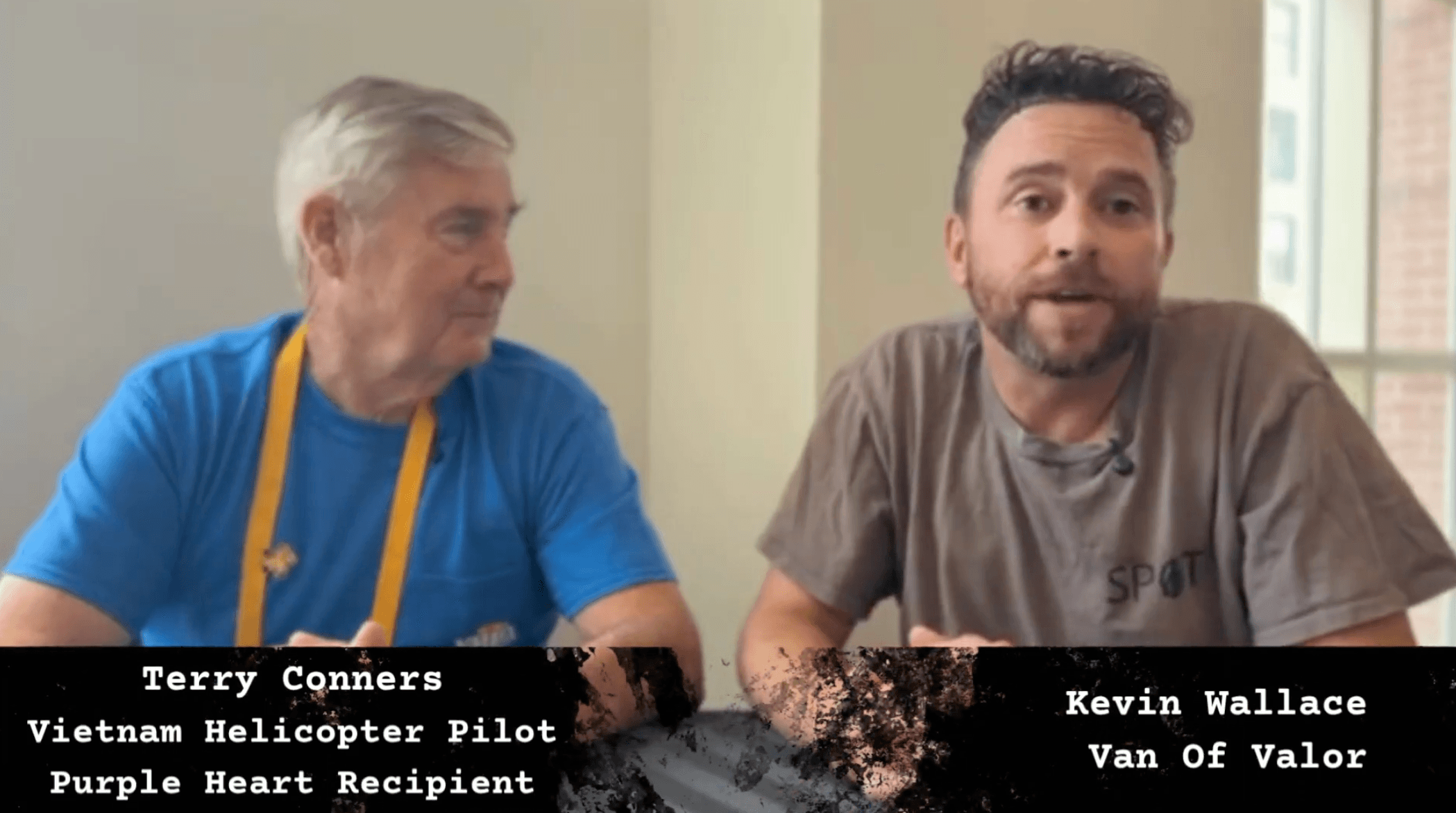
By Dr. Kevin P. Wallace
Van of Valor Project
BARTELSO, Ill. – The October sun over Bartelso had that particular Midwest gold to it—the kind that softens barn roofs and makes cornfields look like they’re lit from within. Terry Conner stood near the Van of Valor, one hand resting on the hood as if steadying himself against a wind only he could feel.
I knew him before we met there. Purple Heart. Scout pilot. First of the Ninth Cavalry—the kind of credentials that make other veterans nod slowly and say, “He was all the way in.” I know several of his brothers. That made this interview personal, deeply personal, for me.
But Terry didn’t need to know any of that.
He was there to talk about school.
“You know what my GPA was in college?” he asked me, before I could even get my recorder situated. “Point zero zero four. They asked me to leave.”
He laughed—a full, genuine laugh that seemed to surprise even him.
“Nineteen years old, draft notice in the mail, and I couldn’t even stay in school. The Army gave me a test. I scored high enough that they guaranteed me flight school right there. The Air Force? They wanted me to wait. See if a slot opened up.”
He signed the papers five days before his draft date.
“The joke was on them,” he said, eyes crinkling. “They thought they were getting some college dropout. Turned out they were getting a pilot.”
Fort Wolters. Fort Rucker. The instructors wore First Cavalry patches—the Cav—and they talked about their unit the way men talk about a woman they’re still in love with. Terry and forty of his classmates walked in to volunteer together.
“I wanted the First of the Ninth,” Terry said. “The reconnaissance squadron. The tip of the spear.”
I asked him if he understood what that meant at the time.
“No,” he said flatly. Then he smiled. “But I found out.”
His Cav unit was its own ecosystem. Scouts in the low-flying birds. Gunships overhead. The Blues—infantry, about a hundred strong—waiting on the strings. They’d find the enemy, fix them in place, and then call in the brigade. Up to eighteen thousand men could drop on a single contact.
“You found them,” I said. “That was your job.”
“We found them,” Terry agreed. “And sometimes they found us.”
He told me about Lou Perazzo.
First Lieutenant. Scout pilot. Gung-ho in a way that made even the aggressive men around him look moderate. Perazzo wanted to command the Blues—wanted it badly enough that he stepped out of the cockpit and into the infantry leadership role. Career move, Terry explained. But also just who Lou was.
“He had this movie camera,” Terry said. “Sent it home to his family. His grandmother, his mother, everybody watching the film. And there we are—five of us—mooning the camera.”
He laughed again, but softer this time.
“His grandmother saw the whole thing. We thought he was going to kill us. But he laughed. Lou always laughed.”
Perazzo died leading his men into a trench. The air crew above him could see what he couldn’t—could see the enemy positions, the kill zone he was walking into. They screamed over the radio. Lou couldn’t hear. Or wouldn’t. The rounds took him in that trench, and the hockey rink they named for him in Boston still carries his name.
“We went to the dedication,” Terry said. “Years later. Stood there looking at his name on that ice.”
There were other stories. The C-ration can that somebody left in the turbine exhaust, the one that exploded on engine start-up and sent every man in the perimeter diving for cover. The NVA battalion they spotted marching in the open, denied permission to engage because they were still in the Marine Corps’ area of operation—until the next day, when the restrictions were lifted and the Cav rolled south.
And then there was October 6, 1967.
Terry was low—treetop level—flying over rice paddies and dikes. Five armed men came out of nowhere. The crew chief, Ronnie, opened up. Terry was setting up a rocket run when the round came through the chin bubble.
“I didn’t feel it at first,” he said. “Not really. I just looked down and my leg was—it was wrong. It had hit the door, the controls. I was in shock. Didn’t even know I’d been hit.”
The other pilot was yelling at him to move his leg. It was draped over the cyclic, and the helicopter was going wherever that leg wanted it to go.
“I reached down with my hand and picked it up. Moved it off the controls.”
Twenty minutes to Chu Lai. The MASH unit. The floor of the helicopter was slick with his blood. When they pulled him out over the seat, the crew thought he was dead.
“I remember giving a thumbs-up,” Terry said. “They told me later they didn’t see it.”
In the MASH tent, he got cold. Death-cold. The kind of cold that doesn’t come from weather. A priest appeared, ready to give last rites.
“I told him to get the hell away from me,” Terry said. “But he said later I was unconscious. So who knows?”
A medic—Terry still doesn’t know his name—noticed a faint pulse in Terry’s groin when the doctor was about to call it. That medic saved his life. Cutdowns at the wrists and ankles, four-point transfusion, pints of blood going in as fast as they could hang them.
Later, the surgeons found the second round. It had entered behind his knee, traveled up his leg, exited, hit the ceramic “chicken plate” in his vest, ricocheted around his hip, and stopped two millimeters from his spine.
“Two millimeters,” Terry said. He held up his thumb and forefinger, showing the gap. “Body fat stopped it. I tell people I was saved by being a little soft in the middle.”
He kept the bullet. Later he had it made into a pendant.
October 6 is his second birthday. Every year, he marks it.
“I’m still here,” he said. “And I still don’t know that medic’s name.”
He’s been searching. St. Louis archives. Unit records. AI tools that can cross-reference duty rosters from the Second Surgical Unit that afternoon in 1967. Some records are gone—lost to fire, flood, or just the slow decay of paper and time.
“But I keep looking,” he said. “Somebody ought to know. Somebody ought to tell him he made a difference.”
I asked him, toward the end, what his best memory was from that year. The kind of question interviewers ask, the kind that’s almost impossible to answer.
He was quiet for a long time. The wind moved through the corn behind the Van of Valor.
“I don’t know that I have one,” he said finally. “Best. Worst. It’s all tangled up. The guys I flew with. The ones who didn’t come back. The pranks. The fear. The way the light looked coming over the mountains some mornings. All of it.”
He looked at me, and for a moment I saw the scout pilot—the man who flew low enough to see the expressions on faces below.
“I’m here,” he said. “That’s the thing. Against every odd, every calculation, every bullet that came through that bubble—I’m here.”
We shook hands before he walked back toward the crowd at the tribute. Veterans in caps. Families with children. The smell of barbecue and the sound of a high school band tuning up somewhere distant.
I watched him go—this man who had lifted his own leg off the controls, who had floated toward the light and cursed the priest away, who carries a bullet in a pendant and a question about a medic he never met.
Terry Conner. Point zero zero four GPA. Scout pilot. Purple Heart.
Still here.
Still looking.
For the medic: if you’re out there, if someone in your family knows this story—Terry Conner wants to thank you. He’s been looking for fifty-eight years. He’ll be at the Van of Valor next year, too. Standing proud. Waiting to say the words he’s been holding onto since October 6, 1967.
To read more, visit www.HelpVoV.com
Make a one-time donation
Make a monthly donation
Make a yearly donation
Choose an amount
Or enter a custom amount
Your contribution is appreciated.
Your contribution is appreciated.
Your contribution is appreciated.
DonateDonate monthlyDonate yearly
Leave a Reply