Commentary by Dr. Kevin Wallace
Van of Valor
MINOT, N.D. – The dashboard of the Van of Valor looked like a tactical operations center as we crossed the 20,000-mile mark of our 27,116-mile journey.
Actual miles … more like 310,000 of FedEx graft, and then happy miles.
As a retired senior master sergeant and Purple Heart recipient, I’ve seen my share of hostile environments.
Admittingly, with a broken and limping van, the four-day sprint through Minnesota and North Dakota in the summer of 2025 offered a different kind of intensity.
We were 160 days into our 280-day trek around the contiguous 48 states, and the Great Plains decided to welcome us with a literal baptism of fire and wind.
Our mission to honor the “North Star” and “Peace Garden” heroes began in St. Peter, Minnesota, where the humidity was so thick it felt like a physical weight.
We sat with Corporal Earl “Sonny” Meyer, a 96-year-old who waited 73 years for his Purple Heart.
The real test came as we pushed into North Dakota. As we transitioned from the lush Minnesota Iron Range — where the story of Wiljo Matalamaki’s recovered medal still haunts the woods — into the vast openness of the Badlands, the weather turned violent.
A “Bow Echo” storm front slammed into the Van with 70-mph straight-line winds.
The horizon disappeared behind a curtain of dust and torrential rain. Lightning didn’t just strike; it webbed across the entire sky, illuminating the jagged buttes of the Theodore Roosevelt National Park in strobe-light flashes.
We white-knuckled the steering wheel as we sought the spirit of Master Sergeant Woodrow W. Keeble near the Lake Traverse Reservation.
Lauren, watching the lightning arc over the plains, shouted over the wind, “This landscape demands a certain kind of soul! You can see why Keeble was unstoppable. To survive this terrain, you have to be as hard as the rock and as persistent as the wind.”
In Surrey and Devils Lake, we met the modern ghosts of the plains: Michael Wing, Dale Thomsen, and Michael Goff.
Goff, a survivor of the Khobar Towers bombing, had told the Patriot Project, “Before you judge a veteran, listen to him first. Because we vet our people, too; and give us a chance.”
As the wind rocked the Van, Lauren reflected on Goff’s words: “The wind here strips everything down to the bone, just like service does. Goff isn’t asking for pity; he’s asking for the same rugged honesty this land demands of its inhabitants.”
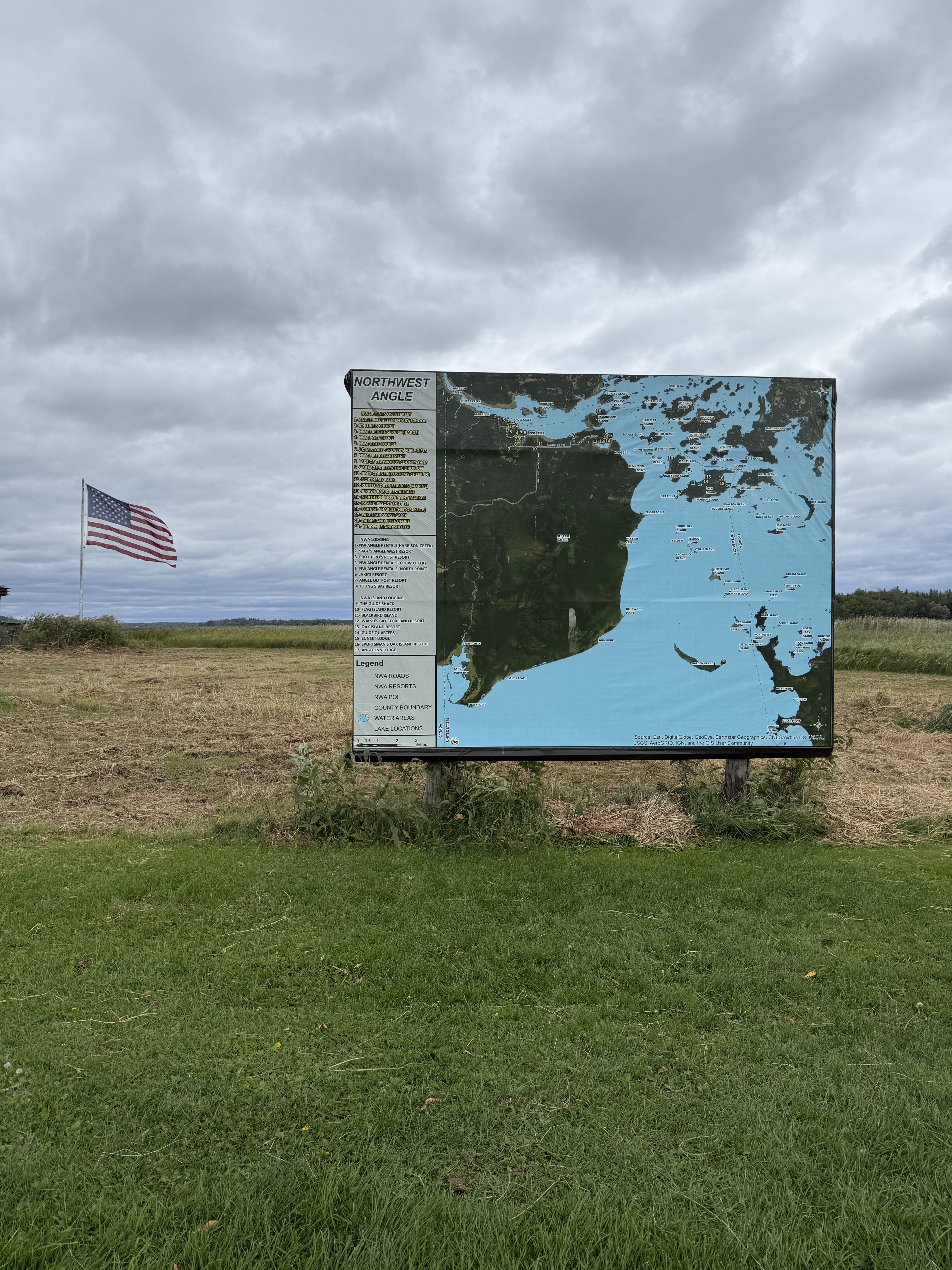
Our final day was a desperate 400-mile dash to the Angle Inlet.
Because the Van couldn’t clear the specific Canadian transit requirements for our timeline, we moved our gear into a rental car, crossing the border under a sky that had finally cleared into a haunting, crystalline blue.
We reached the northernmost point of the lower 48 exhausted but filled with the stories of men like Heath Dakin, the “healer-warrior” medic.
Though our scheduled interview at the Angle fell through, the patriots we met at the local tavern spoke of a service that transcends geography.
Standing at the edge of the map, Lauren looked back toward the wind-swept Badlands we had just survived. “Kevin,” she said, “Our end mileage is just a number. But the four days we spent in the path of these giants… that’s where the map actually becomes a country.”
To contact the Van of Valor, email Manteo.Creative.SPOT@gmail.com. To assist the mission or read more, visit www.HelpVoV.com.
Leave a Reply