Life of service began on Currituck Sound
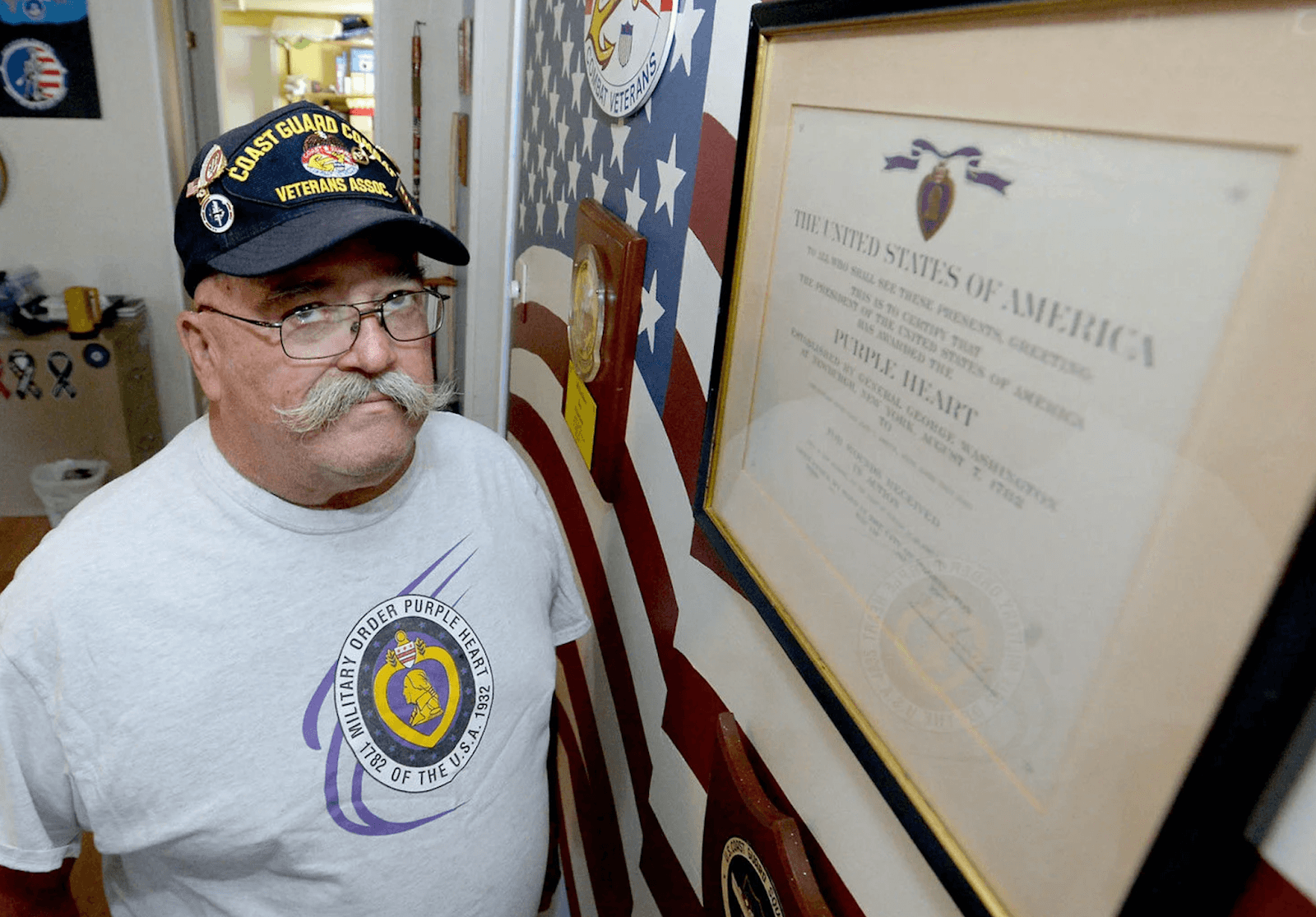
ELIZABETH CITY, N.C. — Anyone who has spent a considerable amount of time in Elizabeth City (EC) must have certainly seen an older man on a rascal scooter, proudly flying an American Flag, Vietnam Service Ribbon Flag, and other veteran memorabilia.
However, one must wonder how many have stopped to chat with, and get to know Butch – he’s not just an incredible character, but he’s among a very scarce cohort – he’s a Coast Guard Purple Heart recipient.
Before he served around the world, Floyd “Butch” Hampton worked on the waters of his native Currituck County, N.C. After graduating from Knapp High School in 1964, he first worked on the construction crew building the bridge from Point Harbor to the Outer Banks, and then at a sailboat factory.
Inspired by two uncles who served, he sought to join the Coast Guard Reserve but initially failed the test to become an aviation electrician’s mate. Undeterred, he enlisted for four years of active duty in 1965.
Butch was wounded in Vietnam while working with the U.S. Army in a mortar pit. The evolution from a Coastie cook to mortar-man came from answering a flyer in the mess hall, said Hampton.
“I was working at the mess hall, I saw the Army needed help and figured I could cook for those boys over there and do my part to help,” he said. “Fast-forward a lot of this and that, I ended up in a mortar pit and got some shrapnel in there. That’s just Vietnam. Crazy, right?”
Make a one-time donation
Make a monthly donation
Make a yearly donation
Choose an amount
Or enter a custom amount
Your contribution is appreciated.
Your contribution is appreciated.
Your contribution is appreciated.
Besides heroism in Vietnam, he also had a full Coast Guard career.
His career began in the unforgiving North Atlantic. As a deck hand on the cutter Bartaria based in Maine, he conducted search and rescue missions and weather patrols near Greenland.
“We put out beacons so Transatlantic aircraft pilots could navigate the ocean,” Hampton said.
He later served on the cutter Ingham out of Norfolk, Va., where winter brought a unique peril.
“The North Atlantic was so cold we would have to use baseball bats to keep the ice off the cutter’s superstructure,” he said.
It was during this time he decided to move below deck, training as a cook in Groton, Conn., which led him to his assignment in EC and, ultimately, to Vietnam.
After recovering from his wounds, Hampton returned to Base EC and continued as a cook before making a final career shift, attending metalsmith school in Memphis, Tenn.
He returned to the EC Air Station, first working on HU-16 flying boats before joining the crews of massive C-130 Hercules aircraft. This assignment took him across the globe.
He was stationed in Kodiak, Alaska, and Borinquen, Puerto Rico. He participated in anti-drug patrols, often staying over at the U.S. base at Guantanamo Bay, Cuba. He also took part in the Coast Guard’s International Ice Patrol, a direct response to the sinking of the Titanic.
Pulling out a photo of the iconic ocean liner, Hampton noted he had been part of crews that flew to the Titanic’s last known position to drop memorial wreaths from the C-130 cargo ramps in tribute.
After retiring from active duty in 1992, Hampton worked as a Coast Guard contractor in EC and later as a commercial crabber and fisherman, never straying far from the water. He remains active with the local Disabled American Veterans chapter.
Reflecting on a career that spanned from the ice of the North Atlantic to the jungles of Vietnam, Hampton’s voice swells with a quiet, enduring pride. His story is not just one of a single explosion in 1969, but of a lifetime of commitment to service in the often-unsung U.S. Coast Guard.“I am proud of my service, every day of it,” he said. “We were always there, doing the job that needed to be done.”
VIEW MORE HERE:www.HelpVoV.com
Make a one-time donation
Make a monthly donation
Make a yearly donation
Choose an amount
Or enter a custom amount
Your contribution is appreciated.
Your contribution is appreciated.
Your contribution is appreciated.
Leave a Reply