Note: This is a corrected story and a repost from the original Nov 2 release.
Nov 4, 2026 · @Dr. Wallace
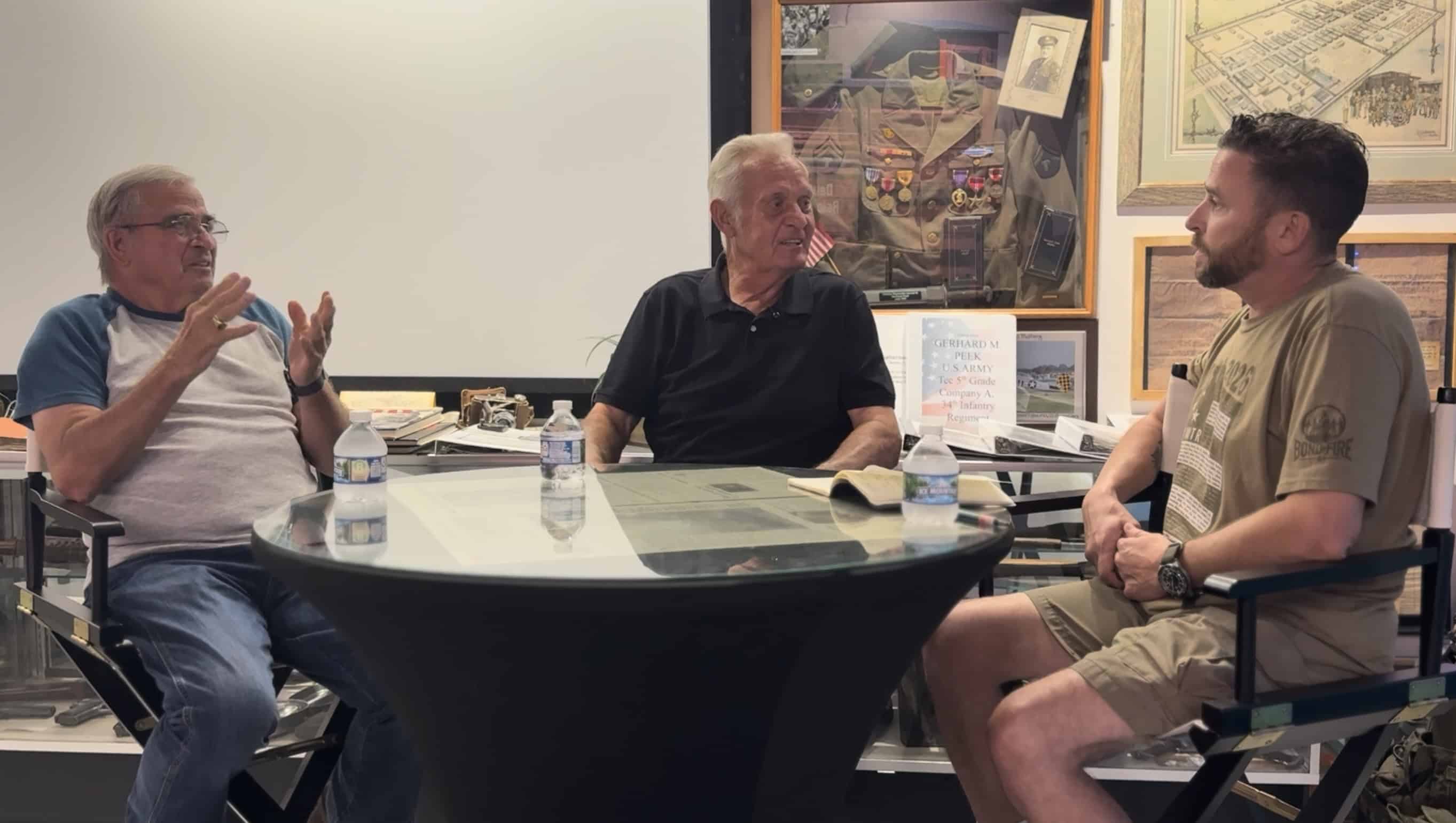
Two brothers and their cousin from a small Clinton County farm town walked into a recruiting office together in 1969. Two of them went to Vietnam. Fifty-seven years later, at the Standin’ Proud Veterans Tribute, Alvin and Jim Huels told their story to the Van of Valor.
BARTELSO, Ill. — The way Alvin and Jim Huels remember it, the decision took one night and one morning.
The young men were fresh out of high school and a year of trade school in St. Louis. The draft was coming for them either way. So one evening the Huels boys — brothers Jim and Ron and their first cousin Alvin — talked it over, and the next morning the three of them walked in on a recruiting sergeant together.
“What can we do for you, boys?” the sergeant asked. Asked during the interview whether they were sober by then, one of them grinned: “No, we weren’t.”
That morning set three young men from Bartelso on very different roads. Ron was sent to Europe. Alvin went to Vietnam as an infantryman and radio operator with the 101st Airborne Division. Jim went as a door gunner on Huey helicopters with the 3rd Squadron, 17th Air Cavalry. They would not see each other again until they were all back home.
On August 8, 2026, Alvin and Jim sat down at the Standin’ Proud Veterans Tribute in Bartelso with Dr. Kevin P. Wallace, a Purple Heart and Bronze Star with Valor recipient who hosts the Van of Valor interviews. Lauren Wallace recorded the conversation on video. Ron could not attend; he was recovering from surgery.
A family that served
For the Huels family, enlisting was less a decision than an inheritance.
Jim and Ron’s father served in World War II as a driver for Gen. George S. Patton. Alvin’s father served too, and the two dads were close. Their grandfathers served. So did their uncles — all but one on each side of the family, who stayed home to keep the farms running.
“None of them ever talked about it,” one of them said. “My grandpas or my dad or my uncles. They never said nothing about it. But you could always feel that they were proud that they did, and never regretted it. I always knew that I was going to do the same.”
Running to Canada, they said, never crossed their minds. “Never,” came the answer, without a pause.
The three cousins went through basic training together. After that, the Army split them up. Ron went to Redstone Arsenal in Alabama to study electronics and radio before his assignment in Europe. Alvin and Jim went to separate advanced training and then, months apart, to Vietnam.
Alvin remembers what his father told him before he left from St. Louis. The old soldier did not cry. “He said, ‘You’re going to come back, and you’re going to be a man. Keep your head on straight.’”
Alvin: ‘Welcome to the company’
Alvin arrived in Vietnam in April 1969. After a few days at Cam Ranh Bay — shots, gear, paperwork — he was sent north to the 101st Airborne in the mountains near the A Shau Valley, the country around Hamburger Hill. First came two days on a 100-foot rappelling tower, learning to hook onto a rope and drop out of a hovering helicopter into jungle where there was nowhere to land.
He did not have long to settle in. His first minutes with his company, a medevac helicopter came in to carry out wounded men.
“Welcome to the company,” someone told him. “You just earned your Combat Infantryman Badge.”
The battalion rotated its four companies: three in the field, one guarding the firebase. Three weeks in the mountains meant carrying everything — water, a week of food, ammunition — about 100 pounds a man, and 50 more for anyone with a machine gun. Every soldier carried a stick of C4 so the unit could blow down trees and cut a landing zone.
Alvin’s company went out with 144 men. Three weeks later, when its turn came to rotate back to the firebase, he said, 67 walked back in. The rest had been killed or wounded.
The youngest men walked point — two soldiers a couple hundred feet ahead of a 30-man platoon, reading the trail for a footprint or a broken twig. “Congratulations for being young,” Alvin said dryly. The enemy waited on the ridgelines. He described the sound he still remembers: a swish, then the blast. “By the time you hit the ground, 90 percent of the time, one or both of them was gone.”
As the war changed, his unit moved from company-sized operations to small squads. By then Alvin had made sergeant, leading six to eight men across an area he compared to the size of Carlyle. At night they sat in a circle around a tree, shoulders touching, so no one could fall asleep on watch.
“You basically didn’t sleep the whole year,” he said.
Later that year his company was rushed north to the DMZ, where a mechanized unit was pinned down. Under a sky full of gunships, he said, they squeezed the enemy for about six days until it broke for the North. And they kept retaking the same ground. “They would take a position,” he said, “and then come back to the same place you just took.”
In his company, nobody got short. Men in other units counted down their last 30 days. “There was nobody going home that didn’t make it that long,” he said. The ones who left early left on a medevac. He remembers a soldier whose leg was torn up, grinning as they loaded him onto the helicopter, glad to be going home alive.
Jim: in the doorway
Jim’s advanced training ran longer. He reached Vietnam at the end of June 1969 and joined the 3rd Squadron, 17th Air Cavalry, flying as a door gunner on Hueys over the Mekong Delta, hundreds of miles south of his cousin.
Where a new infantryman rode the floor of the helicopter — “your whole body is a suction cup,” as the cousins joked, when the pilot banked a thousand feet up — Jim stood in the open doorway behind an M60 machine gun, with thousands of rounds loaded and a second gunner covering the other side.
His job came into focus when the helicopter dropped toward a hot landing zone. “Anything moving,” he said. “Keep everybody’s head down so your guys can get off the ship.” He was protecting the aircraft, too, especially the tail rotor. If ground fire hit it, the helicopter was going down.
His landing zones were rice paddies, not mountaintops, and he is quick to say his cousin had it harder. “I didn’t say I had an easy time,” he said. “I’m just comparing it to what his time was. I wasn’t in the jungle.” Seven men went through training with Jim and landed in the same unit. All seven made it through their year.
Asked to describe what it was like, Jim stopped looking for details.
“I can sit here for a month and talk, and I can’t describe it,” he said. “Chaos. The only word I can think of is chaos.” When the helicopter pulled away from the landing zone, he said, “You’re thinking, what just happened?”
Steaks, milkshakes and a food fight
The trip home came almost as suddenly as the trip over. Alvin flew into Seattle and was processed out at Fort Lewis, where the Army deloused and fumigated the returning men and handed them old armory clothes to travel in.
Then it served them T-bone steaks and milkshakes. Somebody threw some food, and a mess hall full of men straight out of Vietnam erupted. “There’s stuff flying all over,” he recalled, laughing. The cooks stared. A sergeant chewed them out. Nobody cared.
He landed in St. Louis by way of Chicago around 10 o’clock at night. His mother was waiting at the airport.
“I was blessed,” he said. Many men came home to no one, he said. Some wives couldn’t stand what the war had done to their husbands and left, and some of those men took their own lives.
‘Sleep wasn’t a happy place’
What both men return to is how young everyone was. “We’re 19 years old,” Jim said. The first sergeant and the company commander were the old men, at 25 or 28. “Who’s mature at 19, 20 years old?” one of them asked.
When Alvin got home, a sister noticed. He’s different, she said. The war, the cousins said, had made them loners: in Vietnam you learned not to get close to anyone, because you might lose them.
The nightmares did not fade with time. “The longer it goes, then it starts working on you more,” one of them said. For 34 years, Alvin worked night shifts and then farmed during the day. Sleep, he said, “wasn’t a happy place.” He credits his wife with getting him through. The pull to isolate on bad days, he said, is still there.
The country’s thanks came late, and it still sits uneasily. “My kids have brought me five Vietnam veteran hats,” one of them said. “They’re hanging on the door. But I still don’t feel good wearing them.” Part of him still feels bad, he said, for something he never did wrong.
At a traveling replica of the Vietnam Veterans Memorial, set up in a car lot, the old question came back: “How come I got back, and he didn’t?”
An Honor Flight to the memorials in Washington was, in one man’s words, “the best thing ever.”
‘Stand your ground’
Asked whether America was winning when they left, one of them answered simply: “I think we were just there.” What difference the war made, they said, nobody can know.
What they are sure of is why they went: “We went just because we’re from patriotic families.” And they are sure of what comes next. “You still got the freedom that they fought for and won 250 years ago, and you got to keep it,” one said, in the summer of America’s 250th anniversary. “If you don’t protect it and keep what you got, you lose part of it.”
Their advice to the next generation came in three words: “Stand your ground.”
The Army sent Jim, Ron and Alvin in three directions. Home brought them back, and they faced the aftermath together. Jim and Ron’s father never talked about driving for Patton. His son and his nephew decided to talk.
The Van of Valor, founded by Dr. Kevin P. Wallace and Lauren Wallace, records the stories of veterans and Gold Star families across the country so they are never forgotten.
###

Make a one-time donation
Make a monthly donation
Make a yearly donation
Choose an amount
Or enter a custom amount
Your contribution is appreciated.
Your contribution is appreciated.
Your contribution is appreciated.

Leave a Reply