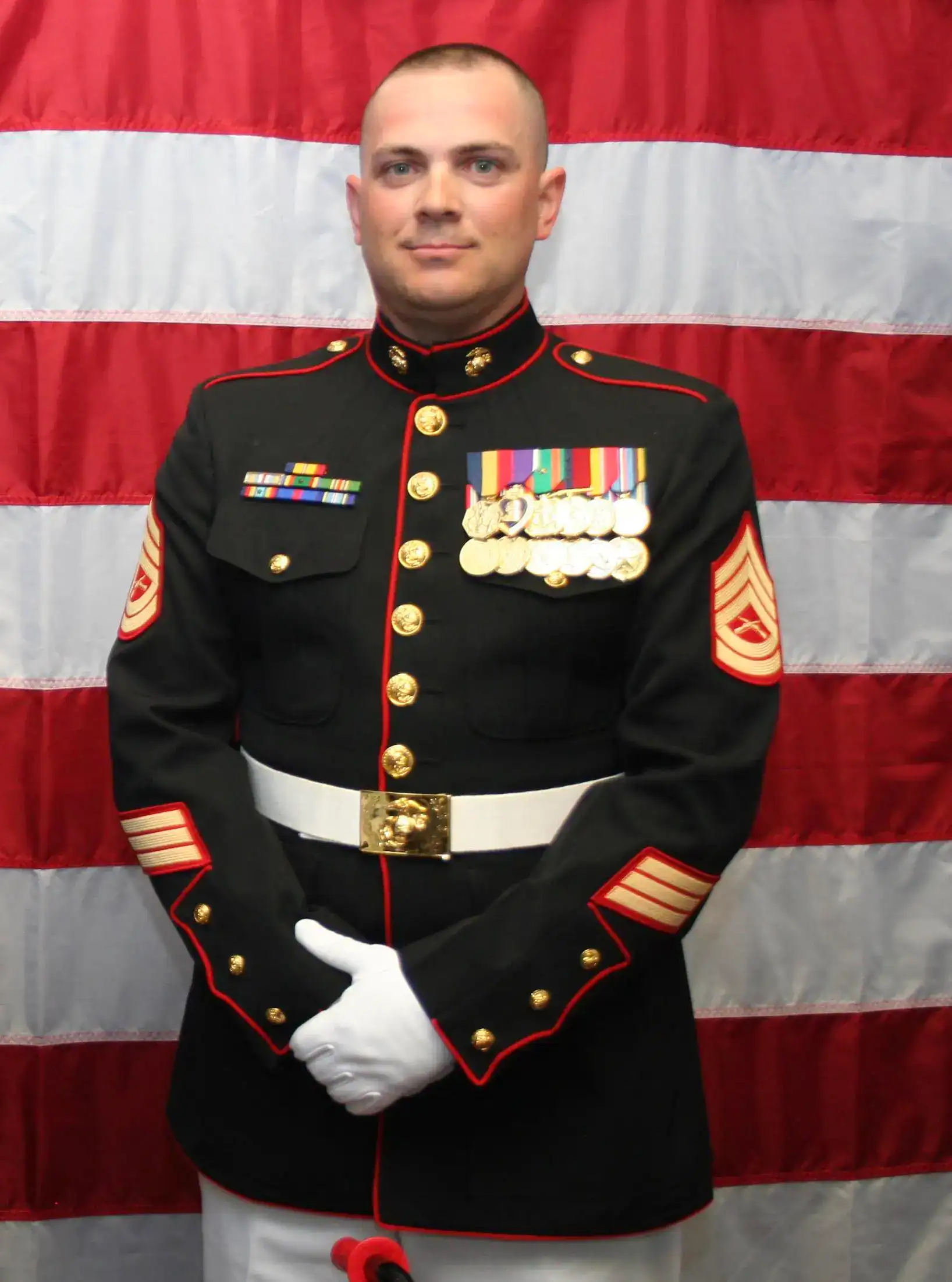
The combat, the courage and the comeback of Gunnery Sgt. Samuel D. Deeds, USMC (Ret.)
A Van of Valor feature for the Marine Corps Birthday · Interview by Dr. Kevin P. Wallace · Recorded by Lauren Wright Wallace · Nov 10, 2026
On November 10, 1775, the Continental Congress called for two battalions of Marines, and the first recruits were signed up at Tun Tavern in Philadelphia. Two hundred fifty-one years later, the Corps is still made of Marines who run toward danger when everyone else is told to stay back.
Gunnery Sergeant Samuel D. Deeds is one of them. He was blown up twice in 30 days in Iraq and kept leading his Marines through both blasts. Three years later, on convalescent leave and still recovering from surgery, he swam into a rip current off North Carolina and helped keep three strangers from drowning.
The first earned him the Purple Heart. The second earned him the Navy and Marine Corps Medal, the Department of the Navy’s highest award for heroism outside of combat. Then he took off the uniform and found a way to keep serving.
Van of Valor sat down with Sam at his home in Northern Kentucky, in an office lined with plaques, challenge coins and the steel rod surgeons once pulled from his leg. This is his story, much of it in his own words.
“No matter where you’re at in your life, you still have worth, you still have value. And if you follow your passion, you will find a new purpose.” — GySgt Sam Deeds
A Mainer, and his father’s son
Sam grew up in Howland, Maine, a small logging town about 34 miles north of Bangor. Logs once came down the river to the sawmill there. His mother, stepfather and sister still live in the house where he grew up, and he goes back every year.
He knew early that he would serve. As a high school sophomore, he found that most recruiters lost interest once they learned his grade. The Marine recruiter didn’t. He took the time to answer every question, and the dress blues didn’t hurt. “I’m biased,” Sam says, “but I feel it’s the best uniform, hands down.”
Only after boot camp did Sam learn the rest of the story. His father had died of leukemia when Sam was eight. His grandparents mailed him his father’s boot camp graduation book, and it showed that his dad had also been a Marine, in a platoon numbered just a few below Sam’s own, Platoon 2076. His father later worked as an avionics technician on the EA-6B Prowler, the most advanced aircraft the Corps had at the time. Decades later, Sam would finish his own career with the MV-22 Osprey, the most advanced aircraft of his era.
About a dozen of his relatives have served, but his father had been the only Marine until Sam. When he walked into the recruiting office he asked for one thing: infantry. The infantry slots in his New England district were full, so his recruiter arranged a one-for-one trade with a recruiting station in Louisville to get them. Sam scored well enough on his entrance test to work on aircraft. He picked the rifle anyway and became an 0311 infantryman.
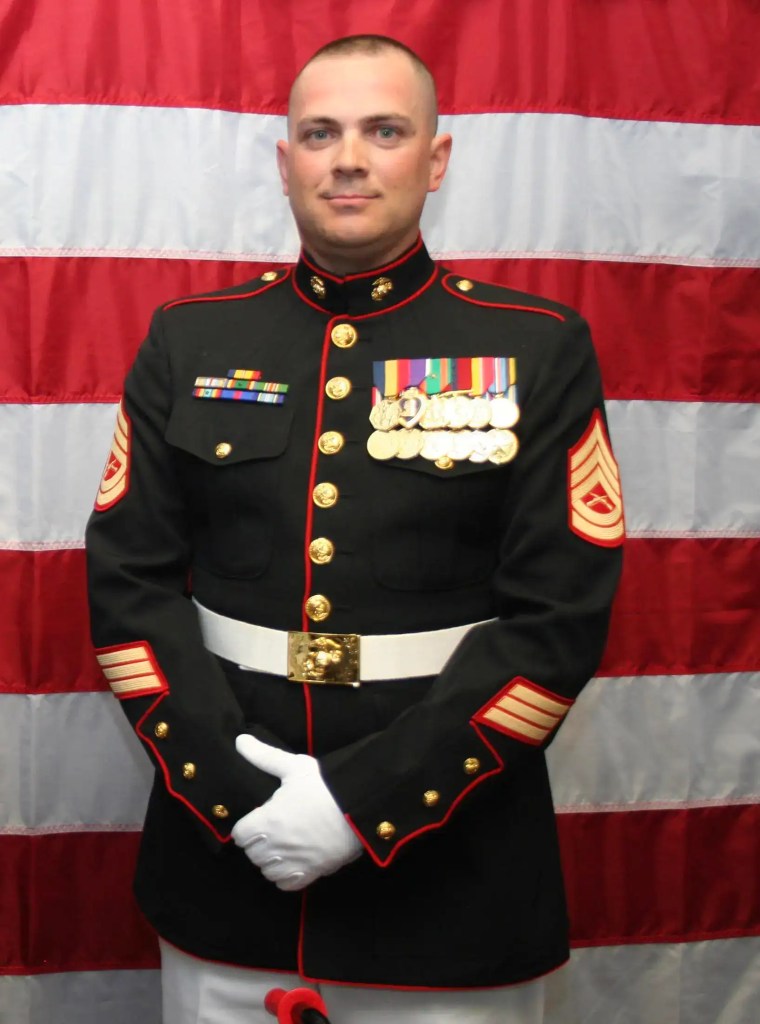
Peacetime grunt, wartime recruiter
Sam joined in 1997, when the world was quiet, so his first years were spent training and deploying. With 2nd Battalion, 8th Marines and later 2nd Light Armored Reconnaissance Battalion, he did a unit deployment to Okinawa and jungle training at Camp Gonsalves, spent two months in Korea, and pulled time aboard ship. In 1999 his unit went to Port-au-Prince, Haiti, as the security element for an Army, Air Force and Coast Guard humanitarian mission. In 2000 he trained with Greek forces near Thessaloniki during the NATO exercise Dynamic Mix.
In March 2001 he was assigned to recruiting duty in Northern Kentucky, southern Ohio and southeastern Indiana. Six months later came September 11. Sam was running paperwork in Cincinnati that morning. When he got back, the recruiting office parking lot was full and he had to park at the high school. A line ran out the door, and in it stood Korea and Vietnam veterans asking him to put them back in. “Old-timer, I appreciate you,” he told them. “You’ve had your time.”
Some of the young men from those towns would later serve beside him in 3rd Battalion, 8th Marines. Two of them would not come home.
Under fire: Haiti and Abu Ghraib
After recruiting duty, Sam chose 3rd Battalion, 8th Marines. He married his wife, April, that spring, and about ten days later he was on his way to Haiti again. Because he had been there in 1999, the battalion wanted him there in 2004.
That 2004 mission began as peacemaking, became peacekeeping and ended as humanitarian work, and it counted as a combat deployment. Sam was ordered to Kilo Company in the south with two hours’ notice and went in by helicopter. Near the port, windows blew out around his Marines as gunmen fired at Haitian police. Gangs were fighting to control the port, and in 2004 Marines could detain the aggressors. Although he was still a sergeant, Sam was moved into a platoon sergeant’s billet, a job normally held by a staff sergeant.
In January 2005, 3/8 deployed early to Iraq to secure the country’s first free elections. Kilo Company lived inside the walls of Abu Ghraib prison, and Sam slept in a maximum-security cell beside the showers. The company covered ground from the west wall of Abu Ghraib to the east edge of Camp Fallujah, almost entirely on foot. For the first weeks, Sam or his platoon commander had to be on every patrol. He was sleeping five or six hours a night, if that. During the elections, mortars and rockets came in almost daily.
The first blast: February 19, 2005
About 35 days in, Sam’s platoon was walking back from the Iraqi National Guard base after a rain. The mud was the kind that builds up on a boot with every step, so he kept his Marines on a freshly paved road. He stepped to the edge of the formation and turned to check on his men. At that moment a buried mortar shell exploded.
The blast threw him five to eight feet and knocked him out. One of his Marines was thrown into a chain-link fence, and his machine gun’s charging handle drove into his leg. When Sam came to, he saw two men acting suspiciously and chased them alone through houses and alleys. Only when he turned around did he realize he was by himself. When he got back to the platoon, a lance corporal handed him a lump of mud. Inside was Sam’s 9mm pistol, which had torn loose during the blast and the chase. He hadn’t noticed.

The second blast: March 20, 2005
Thirty days later, his squad was ordered to set up a vehicle checkpoint north of Kandari Market Road. Sam noticed a rock pile beside the road that hadn’t been there when they passed by a few hours earlier. “Something didn’t feel right,” he says.
He trusted that instinct. He sent the Humvee and the rest of the squad around the danger area and left a fire team behind as rear security, because an earlier IED had been planted after a patrol left its route unwatched. He moved the vehicle farther north than ordered. Then he went back to inspect the rock pile himself. Still uneasy, he headed for the Humvee to call the engineers.
Then he heard two of his Marines walking into the danger area. Sam turned back toward the IED to warn them off. Only after he saw they were clear did he head back to the Humvee. That was when the insurgents set off the bomb: a 155mm artillery shell buried on each side of the road.
The blast threw him 20 to 30 feet, and he landed in front of the Humvee. Investigators later concluded that the two blast waves met and spread out right where he stood. A foot in any direction, they said, and he would have been killed. His machine gunner, Lance Corporal McNaughton, took shrapnel in both shoulder blades and stayed on the gun all the way back to base.
Sam came to with his corpsman giving him morphine and tourniquets on almost every limb. He had just been moved back to squad leader, and no one else on the scene knew how to call in a medevac. So he lay on the ground and talked the Humvee driver through his own nine-line medevac request. His Marines got him back through the Abu Ghraib gate before the quick reaction force had even reached the intersection.
The list of his wounds is long:
- Two grade-2 concussions and two traumatic brain injuries in 30 days, later followed by post-traumatic stress
- Two broken bones in his left hand
- Shrapnel in his left forearm, right hand, left thigh and right groin
- A half-inch chunk torn from his left tibia, later rebuilt with a steel rod
- Shrapnel lodged on both sides of his femoral artery, within millimeters of it, where it remains today
He received the Purple Heart. He has since had 46 surgeries and procedures, including a reconstruction of his bile ducts at UNC Chapel Hill after the blasts damaged his gallbladder. Today the rod pulled from his leg hangs in his office, mounted on the lid of a crate that once held shaped demolition charges.

Into the rip current: the Navy and Marine Corps Medal
On September 11, 2008, Sam was on convalescent leave after one of his abdominal surgeries. He was at Emerald Isle, North Carolina, with April, their oldest son and his in-laws. A tropical storm had brushed the coast a day or two earlier, and the surf was still rough.
Far offshore, a woman began waving her arms. She was caught in a rip current. Her husband charged into the water after her, and soon both were being pulled farther out. A second man, Paul, paddled out to them on a child’s foam boogie board and left it with the couple. Halfway back to shore, Paul began to go under. People on the beach had called 911, but there were still no sirens and no rescue crews in sight.
Sam tore off his abdominal wrap as April watched in alarm. He grabbed a child’s inflatable raft, wrapped its rope around his arm and swam into the current. He reached Paul just as Paul slipped under. Sam reached across the raft, pulled him up by the hair and had him hold on to the oar lock.
For about 15 minutes, Sam did what you are supposed to do in a rip current and swam parallel to the beach, towing Paul. They made no headway and kept drifting farther out. The raft was filling with water, and so were both men. When rescuers finally arrived on a personal watercraft with a rescue sled, they told Sam to get on. He refused, sending them to the couple first, and then sending them back for Paul. Only after all three were safe did Sam let a rescue swimmer bring him in.
Paul turned out to be a North Carolina general contractor; his wife, their newborn and his friends were watching from the beach. The husband and wife he had gone out to help had young children on the sand too.
Sam’s command learned what happened and nominated him for the Navy and Marine Corps Medal. It is the Department of the Navy’s highest award for heroism outside of combat, and it ranks above the Bronze Star. The award credited him with directly saving one life and, by turning down rescue and sending the rescuers on, saving two more. He was promoted to gunnery sergeant and received the medal on the same day, the day before his birthday.
Sam doesn’t like the attention. “At the end of the day,” he says, “there are three people still alive today because of actions I took.” Years later, on a trip back to North Carolina with his oldest son, he walked into Paul’s office unannounced. A man in the waiting room recognized him and left in tears. He had been on that beach and had watched the whole thing. Sam and Paul talked for 45 minutes. Sam shared the witness statements and his medal citation, and gave Paul one of his challenge coins.

The long road, and the names he carries
The wounds ended Sam’s time in the infantry, but not his service. He was promoted to staff sergeant in 2005. At 6th Marine Regiment he served as operations chief while still an E-6, filling a billet meant for an E-9. He then moved to aviation, joined an MV-22 Osprey squadron and served as its squadron gunny. When traumatic brain injury was finally recognized in 2007, he went through years of cognitive therapy and took part in a nine-week Department of Defense study in San Antonio in 2010.
In 2011, after more than 30 surgeries, a medical board ruled that he could no longer perform the basic duties of a Marine. He had two weeks between that decision and his retirement, with no time to prepare for civilian life. After 14 years of leading, training and mentoring Marines, he came home to Northern Kentucky with almost nothing lined up.
The Samuel Deeds 400
In 2013, public voting through the Crown Royal “Your Hero’s Name Here” program, which raised money for the Armed Forces Foundation, put Sam’s name on one of the most famous races in America. The NASCAR Sprint Cup race at Indianapolis Motor Speedway on July 28, 2013, was run as the Crown Royal Presents the Samuel Deeds 400 at the Brickyard. Sam, a lifelong NASCAR fan who had dreamed in Iraq of working in the sport, presented the trophy to winner Ryan Newman. A signed photo of that day now hangs on his office wall.
The honor gave him a platform. He worked with a foundation focused on traumatic brain injury, post-traumatic stress and veteran suicide, and helped raise $1.1 million at a Barrett-Jackson auction. He also told his story on national television in Ron White’s Comedy Salute to the Troops. A veteran Sam had met years earlier at a racetrack watched that broadcast. That man had survived a suicide attempt, and he decided that if Gunny could talk about it, he could too. He began sharing his own story, and he is still here today.

The fallen
Sam’s office wall also holds the Kentucky Veterans Hall of Fame (class of 2016), the President’s Lifetime Achievement Award for more than 4,000 hours of volunteer service (2018) and the State of Maine’s Silver Star Honorable Service Medal for combat-wounded veterans. He says all of it will end up in a box someday. What stays with him are the Marines who didn’t come home.
One was Lance Corporal Taylor B. Prazynski of Fairfield, Ohio. Sam picked him up at the School of Infantry and took him to Haiti with 3/8. Taylor was killed in Iraq in May 2005.
Another was Corporal Christopher Tyler Warndorf of Burlington, Kentucky. Sam was his recruiter, and because Chris was 17, his mother, Tina, had to sign the parental consent. Sam promised all his recruits he would check on them once he got back to the fleet. One day in 2004, Chris came around a corner at the exchange in Haiti and found his old recruiter standing there. “I told you I was going to check up on you,” Sam told him. Chris was killed in Ramadi on August 29, 2006, two months before he was due home from his third combat tour in three years.
Sam couldn’t make it to Chris’s funeral; his oldest son had just been born, and his command wouldn’t release him. “I should have fought harder to come home,” he says. Chris is buried in Northern Kentucky. Sam visits every Memorial Day and every anniversary, and Tina always seems to know. “I’ll get a text from his mom saying, ‘I know you’re here,’” he says. “There’s a fresh dime on the marker.”

A new mission
In 2014, Gold Star father John Prazynski invited Sam to jump out of an airplane. The Team Fastrax professional skydiving team was hosting combat-wounded veterans and Gold Star families at its Warrior Weekend to Remember in southwest Ohio. That first year Sam attended, 17 Purple Heart recipients and one Gold Star father took part. Tina Warndorf was there too. Sam had not spoken to her since before Chris died, and he didn’t know how she would receive him. “Nothing but love,” he says, from her and the whole family.
A week or two later, a jumper was hurt landing at a nearby show. Sam vaulted a wall, gathered up the team’s gear and stowed it properly. Team Fastrax invited him to join. Today he is the team’s grounds coordinator and an alumni ambassador for its Blue Skies for the Good Guys and Gals Warrior Foundation, which now brings dozens of Purple Heart warriors and Gold Star families together every summer.
“That gave me a sense of purpose again,” Sam says. “I’m not leading, training, mentoring young men and women anymore. But I’m having an impact on people I’ve never met, who were in places I was in, or worse.” April and their sons, including youngest son Miles, back him completely and often come along.

He is honest that the dark days still come, especially around February 19 and March 20, the dates of the two blasts. “Every day is a bear,” he says. “Some days it’s a teddy. Some days it’s a grizzly. You just have to learn how to tame your grizzly. Feed him a salmon.” For Sam, that salmon is fishing. With a line in the water, the bills, the worries and the memories go quiet for a while, and he is a better man when he comes home, fish or no fish.
He also co-hosts the HomeFront SitRep podcast with David Willis, live on YouTube, LinkedIn, Facebook and TikTok every Sunday and Monday at 7 p.m. Eastern. Every episode ends the same way, and so does this story:
“No matter where you’re at in your life, you still have worth. You still have value. And if you follow your passion, you will find a new purpose. That $1 bill that’s been on the ground and stepped on is still worth $1 at the end of the day.”
On the Marine Corps’ 251st birthday, we salute Gunnery Sergeant Samuel D. Deeds: rifleman, recruiter, platoon sergeant, Purple Heart recipient and lifesaver. Happy birthday, Marines. Semper Fidelis.
Van of Valor travels the country to record the stories of Purple Heart recipients and Gold Star families, because the highest form of honor is to remember.
Sources: Van of Valor interview with GySgt Samuel Deeds (2026); NASCAR: U.S. Marine honored as Brickyard 400 namesake; Wikipedia: 2013 Brickyard 400; Military Times: Cpl. Christopher T. Warndorf; Travis Manion Foundation: LCpl Taylor B. Prazynski; PRWeb: Team Fastrax Warrior Weekend to Remember
Photo credits: Photos of Sam’s office, awards and memorabilia: Photo by Dr. Kevin P. Wallace. All other photos of Sam: Courtesy photo (public domain).

Make a one-time donation
Make a monthly donation
Make a yearly donation
Choose an amount
Or enter a custom amount
Your contribution is appreciated.
Your contribution is appreciated.
Your contribution is appreciated.
Leave a Reply